- Ultrasound Reprocessing Solutions
- Endoscope Reprocessing Solutions
- Introducing
- Products & Solutions
- Learning & Support
- Featured
- Nanosonics Academy
- About Us
- Investor Centre
- The Centre
You are currently on
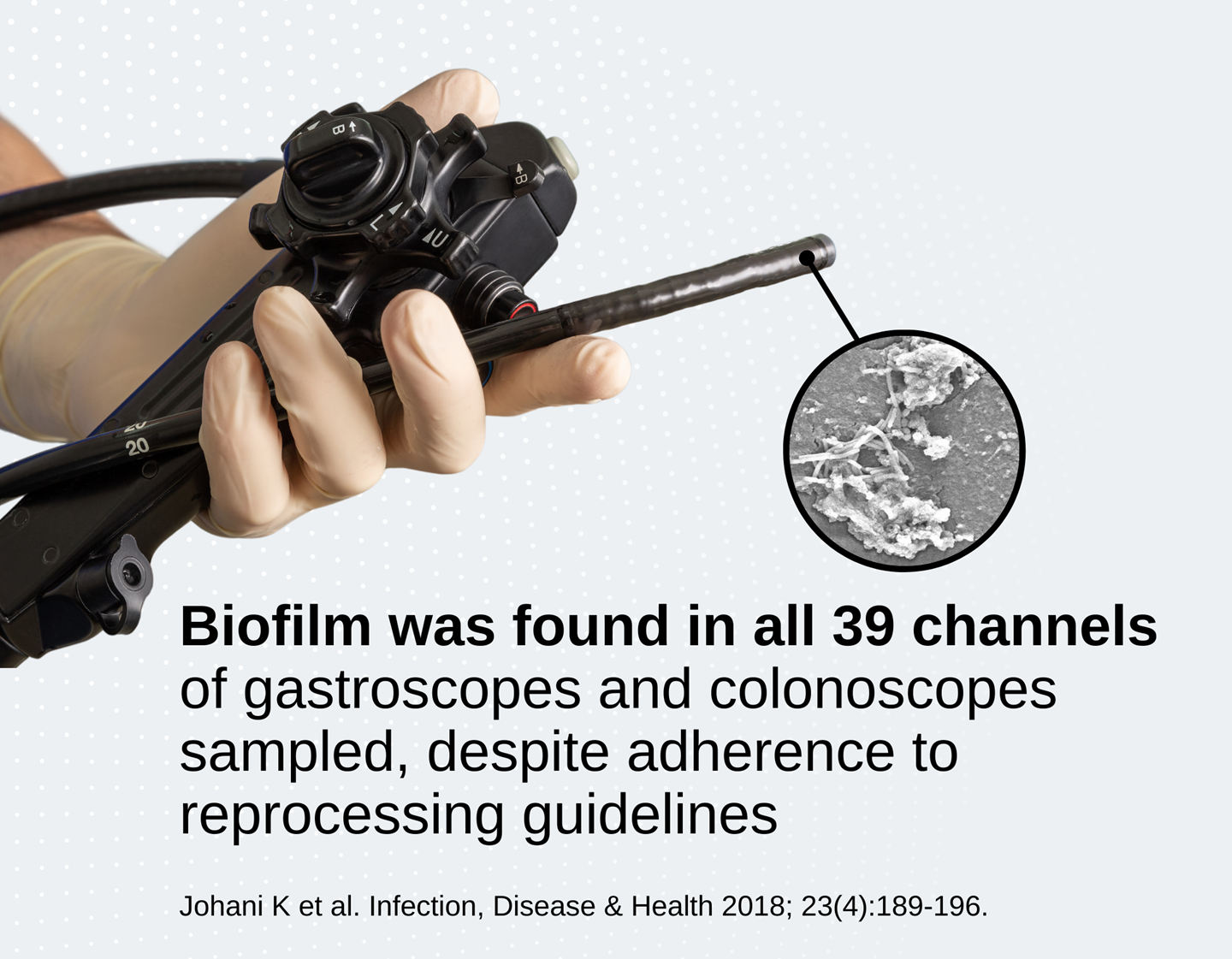
Persistently contaminated endoscopes can act as reservoirs and harbour biofilm, even after reprocessing.4,5

In a clinical study, the majority of gastroscopes had biofilm in multiple channels after 60 days of patient use/reprocessing cycles5
Microbes present in the environment, including those in contaminated endoscopes in clinical use, predominantly exist in biofilms.1 Tests to assess the efficacy of endoscope cleaning and reprocessing must therefore include models that simulate biofilms.
It is essential that biofilm is removed during the manual cleaning stage, as evidence suggests it may be able to survive high-level disinfection.6 This resistance can develop further over time as residual dead cells (biomass) accumulates.7

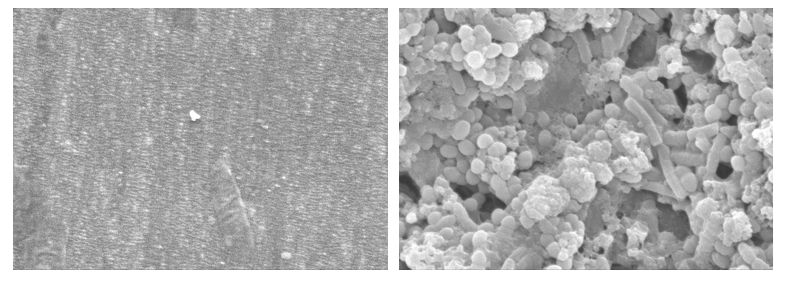
Comparison of 1.4mm PTFE tube (to simulate air/water and auxiliary channels) without biofilm (left) and with biofilm (right). 8000X magnification.
Resistant strains of biofilm are also emerging. Carbapenem-resistant enterobacterales (CRE) show increased tolerance to peracetic acid (PAA) when grown as a biofilm.8 K. pneumoniae isolated from an outbreak involving a duodenoscope showed weak resistance to PAA in its planktonic (free-living) form. When grown as a biofilm, the bacteria showed resistance to PAA even at a concentration used for high-level disinfection.
Any bacteria that is not removed during the cleaning process can form biofilms inside the endoscope, resulting in reprocessing failure.
Kovaleva J.
Infectious complications in gastrointestinal endoscopy and their prevention. Best Pract Res Clin Gastroenterol. 2016 Oct;30(5):689-704.
Multiple studies have demonstrated that a single strain of bacteria can be transmitted to patients via the same endoscope, over a period of months:
These reports show that endoscopes can act as reservoirs for pathogens, despite repeated cleaning and reprocessing.
Given this evidence, it is likely that the formation of protective biofilms allows pathogens to persist in endoscopes over time.

Multiple cycles of reprocessing and drying can cause endoscopes to develop a tougher form of biofilm that can be more difficult to remove.11,12

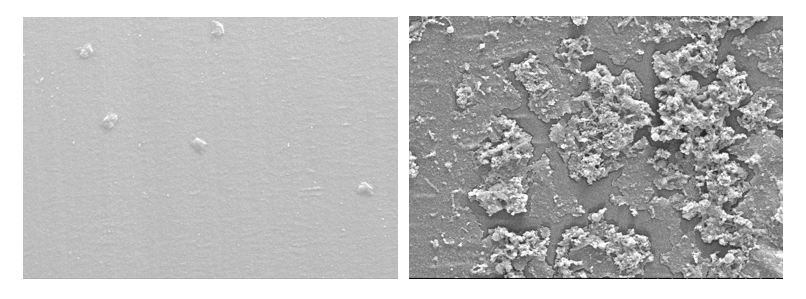
Comparison of 3.7mm PTFE tube (to simulate suction biopsy channel) without biofilm (left) and with biofilm (right). 1000X magnification.
Biofilm found in endoscopes in clinical use is often fixed to the surface from repeated cycles of HLD and drying, meaning mechanical action is critical for its removal.11 It may be impossible to remove this biofilm even after multiple rounds of standard cleaning and disinfection protocols, requiring the endoscope channel to be replaced.13
The cyclic-buildup biofilm model, developed by Alfa et al.10, represents the multiple cycles of HLD and drying that can cause biofilm to become fixed. This model is the closest available representation of biofilm isolated from endoscopes in clinical use.
Traditional models are usually single-organism biofilms that are continuously hydrated, and do not model the growth of biofilm in channels of different diameters.14
| Clinical Biofilm(isolated from contaminated endoscopes) | Cyclic-buildup Biofilm11 | Traditional Biofilm 14 | |
| Includes potential GI pathogens | ✓ | ✓ | ✓ |
| Grows in polytetrafluoroethylene (PTFE) channels | ✓ | ✓ | - |
| Consists of multiple organisms | ✓ | ✓ | - |
| Grows over >5 days | ✓ | ✓ | - |
| Subjected to multiple cycles of drying/wetting | ✓ | ✓ | - |
| Crosslinking of amino acids induced by fixative chemicals | ✓* | ✓ | - |
| Cycles of reinoculation | ✓ | ✓ | - |
| Grows in both small and large channels | ✓ | ✓ 1.4 mm and 3.7 mm diameter PTFE tubing | - 6mm diameter tubing only |
*Where glutaraldehyde (GTA) and ortho-phthalaldehyde (OPA) are used