- Ultrasound Reprocessing Solutions
- Endoscope Reprocessing Solutions
- Introducing
- Products & Solutions
- Learning & Support
- Featured
- Nanosonics Academy
- About Us
- Investor Centre
- The Centre
You are currently on
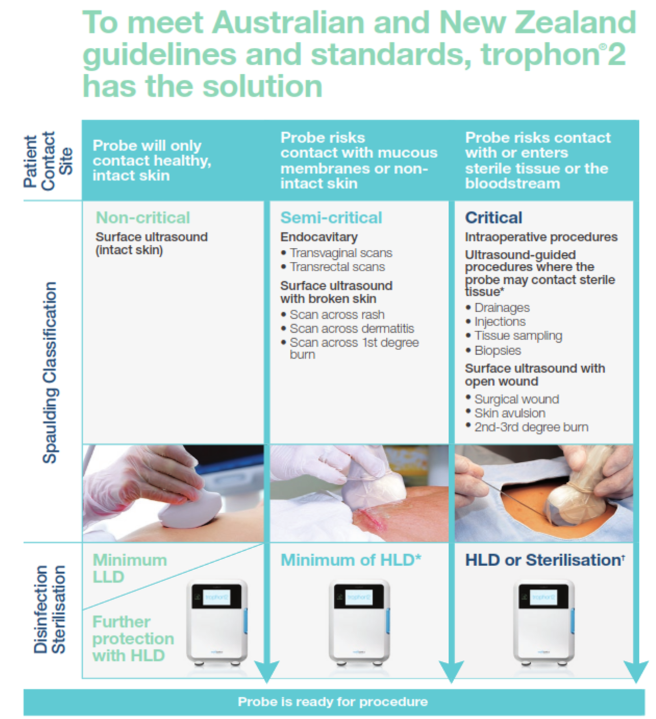
Table 1: Overview of The Spaulding Classification.1-7
Spaulding Classification | Medical Device Contacts | Risk of Infection Transmission | Disinfection Level |
Critical | Sterile tissue or the bloodstream | High | Sterilisation* |
Semi-critical | Mucous membranes or non-intact skin | Medium | High-Level Disinfection (HLD) |
Non-critical | Intact skin only | Low | Intermediate-level (ILD) or Low-level disinfection (LLD) |
* Critical ultrasound probes can be high-level disinfected and used with a sterile sheath if sterilisation is not possible.6,7
HLD must be used for critical ultrasound probes if sterilisation is not possible, a sterile sheath must also be applied to the probe.
Ultrasound probes are delicate, heat sensitive medical devices that cannot undergo steam sterilisation. Low temperature sterilisation methods require the probe to be out of circulation for extended periods of time, disrupting clinical workflow.
Critical probes can be high level disinfected if sterilisation is not possible, however the probe must also be covered with a sterile sheath at use.
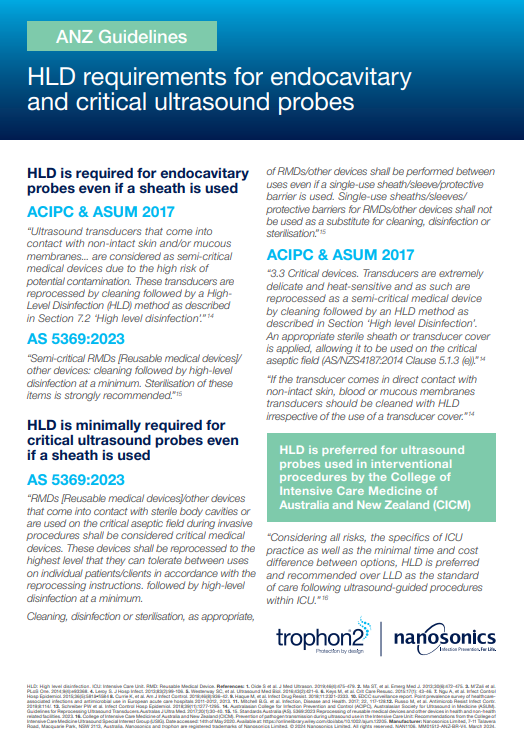
"RMDs [Reusable medical devices]/other devices that come into contact with sterile body cavities or are used on the critical aseptic field during invasive procedures shall be considered critical medical devices. These devices shall be reprocessed to the highest level that they can tolerate between uses on individual patients/clients in accordance with the reprocessing instructions. followed by high-level disinfection at a minimum.
Cleaning, disinfection or sterilization, as appropriate, of RMDs/other devices shall be performed between uses even if a single-use sheath/sleeve/protective barrier is used. Single-use sheaths/sleeves/protective barriers for RMDs/other devices shall not be used as a substitute for cleaning, disinfection or sterilization."

""Transducers are extremely delicate and heat sensitive and as such are reprocessed as a semi‐critical medical device by cleaning followed by a HLD method as described in Section ‘High‐level disinfection’. An appropriate sterile sheath or transducer cover is applied, allowing it to be used on the critical aseptic field (AS/NZS4187:2014 Clause 5.1.3 (e))."

HLD is minimally required for semi-critical ultrasound probes, a sheath must also be applied to the probe.
"Semi-critical RMD/other devices: cleaning followed by high-level disinfection at a minimum. Sterilization of these items is strongly recommended"
"Ultrasound transducers that come into contact with non‐intact skin and /or mucous membranes...are considered as semi‐critical medical devices due to the high risk of potential contamination. These transducers are reprocessed by cleaning followed by a high‐level disinfection (HLD) method as described in Section 7.2 ‘High‐level disinfection’."

HLD can optionally be used for non-critical probes, however low level disinfection is sufficient.
Non-critical probes will only contact healthy, intact skin. Low level disinfection (LLD) is sufficient for these probes. However, optionally performing HLD ensures the probe is ready for any subsequent procedure.
Learn about HLD with the trophon®2 device. The trophon2 device can integrate with the range of clinical workflows to help keep your patients safe from cross-infection.
Over 1,000 probes from 25 manufacturers are tested, approved and endorsed for use with trophon devices. View the probe compatibility list.


The trophon® family includes trophon® EPR, trophon®2 and trophon®3 which share the same core technology of 'sonically activated' hydrogen peroxide.